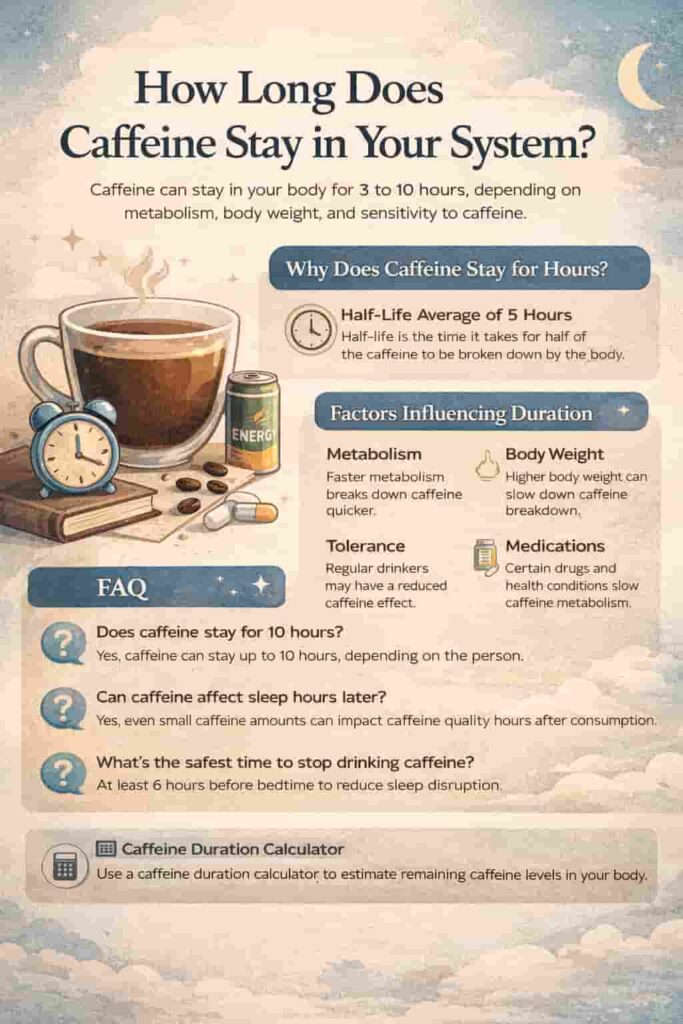
Estimate how much caffeine is still in your body, when it may stop affecting sleep, and when it will fully leave your system.
How long does caffeine stay in your system is a common question for coffee drinkers, students, and anyone trying to avoid sleep problems. In most healthy adults, caffeine stays in the body for about 3 to 10 hours, although the exact duration depends on metabolism, body weight, caffeine sensitivity, and how much caffeine was consumed.
After drinking coffee or an energy drink, caffeine is absorbed quickly into the bloodstream. Most people begin to feel the stimulating effects within 15–45 minutes. Peak caffeine levels usually occur around 30–60 minutes after consumption.
Even when the alert feeling fades, caffeine can remain in the body for several hours. Understanding how long caffeine stays in your system can help you manage caffeine intake and avoid sleep disruption.
Use the caffeine duration calculator above to estimate how much caffeine may still be in your body. The tool calculates the approximate caffeine remaining based on the drink you had and how many hours have passed since consumption.
This calculator is designed to give a realistic estimate based on the average caffeine half-life in adults.
The caffeine calculator is simple to use and only takes a few seconds.
Choose the type of drink you consumed. Different beverages contain different caffeine levels. For example, an Americano typically contains about 95 mg of caffeine, while green tea contains around 40 mg.
Input the number of hours since you consumed the beverage. The calculator uses this value to estimate how much caffeine remains in your system.
After clicking the calculate button, the tool will display the estimated caffeine remaining in your body and whether the level is likely to affect sleep.
How long caffeine stays in your system is mainly determined by its half-life. The average caffeine half-life in healthy adults is about 5 hours. A half-life is the time it takes for the body to eliminate half of the caffeine consumed.
For example:
If you consume 100 mg of caffeine
After 5 hours → about 50 mg remains
After 10 hours → about 25 mg remains
Because caffeine breaks down gradually, small amounts can remain in the body long after the stimulating effects fade.
Several factors influence how quickly the body processes caffeine.
People with faster metabolism break down caffeine more quickly, while others may process caffeine more slowly.
Individuals with higher body mass may experience slightly weaker caffeine effects compared to smaller individuals.
Regular coffee drinkers often develop tolerance, meaning caffeine may feel less stimulating even though it remains in the body.
Certain medications and liver conditions can slow down caffeine metabolism.
During pregnancy, caffeine metabolism can slow significantly, causing caffeine to stay in the body longer.
Although caffeine may remain in your system for several hours, the noticeable stimulating effects usually last about 4–6 hours.
During this time caffeine blocks adenosine, a neurotransmitter responsible for making you feel tired. This is why caffeine helps increase alertness, focus, and energy.
However, consuming caffeine late in the day may still affect sleep because small amounts of caffeine can remain in the body for many hours.
Yes, caffeine can stay in your system for up to 10 hours in some individuals. However, the exact duration varies depending on metabolism, caffeine intake, and personal sensitivity.
About half of 100 mg of caffeine will remain after roughly 5 hours. Smaller amounts can still remain in the body for 10 hours or more.
Yes. Even small amounts of caffeine remaining in the bloodstream can interfere with sleep quality, especially for people who are sensitive to caffeine.
Many sleep experts recommend avoiding caffeine at least 6 hours before bedtime to reduce the risk of sleep disruption.
Many people search how long does caffeine stay in your system after drinking coffee late in the day.
Understanding how long does caffeine stay in your system can help you avoid sleep problems.
The answer to how long does caffeine stay in your system depends on metabolism and caffeine intake.
If you drink coffee regularly, you may wonder how long does caffeine stay in your system before bedtime.
Health experts often explain how long does caffeine stay in your system using the caffeine half-life.
Knowing how long does caffeine stay in your system helps you manage caffeine consumption more safely.
Understanding how long caffeine stays in your system can help you make better decisions about when to drink coffee, tea, or energy drinks. While caffeine provides a temporary boost in alertness, it is important to manage intake carefully to avoid sleep issues.
Use the caffeine calculator above whenever you want a quick estimate of how much caffeine may still be in your body.
If you’re researching sleep problems, these guides may also help you understand common causes of fatigue and sleep disruption.